Episode Transcript
[00:00:02] Speaker A: Welcome to the @pit crew podcast. This high energy show dives deep into the world of sports emergency care. Join us as we explore cutting edge strategies, real world experiences and expert insights to help you step up your game in emergency care. We've got the tools, tips and stories you need to be ready when seconds matter. It's time for the @pit crew podcast. We have the green light in three, two, one.
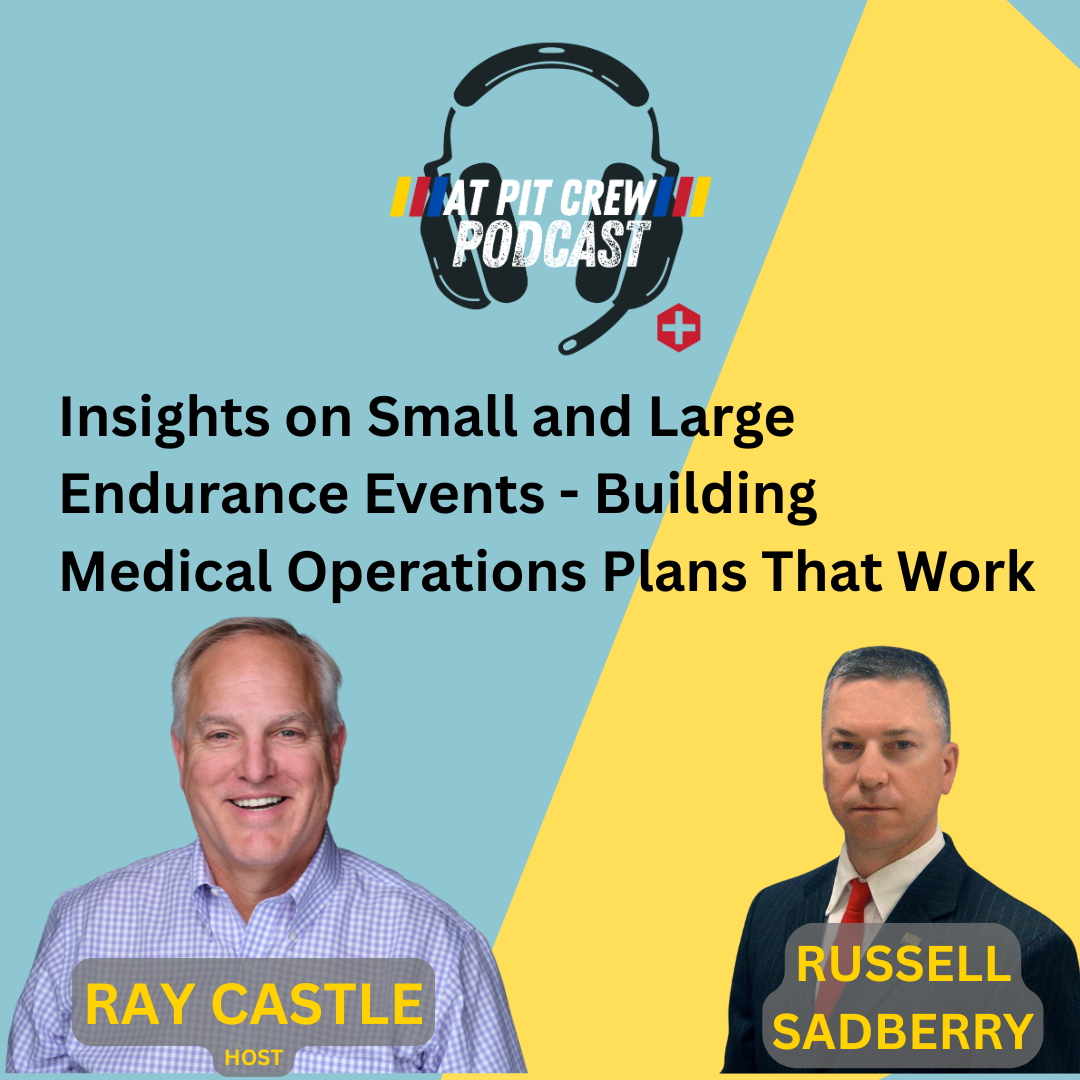
[00:00:32] Speaker B: Welcome to the @pit crew podcast. I'm Ray Castle and today we're thrilled to have Russell Sadberry, an athlete trainer at Katy Independent High School in the Houston, Texas area. And the topic is endurance events and ultra endurance events. And what we look at from a medical operations planning for large and small scale activities. Russell has a great, tremendous experience in athletic training a number of different covering events and he brings a unique perspective.
One because he's worked with some of the larger events like the Houston Marathon and then also has also worked in ultra endurance events. But also from a standpoint, his wife is also an accomplished distance or marathon and ultra marathon runner. So bringing that perspective of what you see on both sides. I think we're going to have a lot of fun today. So welcome to show Russell.
[00:01:23] Speaker C: Thank you. Glad to be here.
[00:01:24] Speaker B: Great. Again you tell if you would just take just a couple of minutes, just tell, tell the audience a little bit about yourself.
[00:01:29] Speaker C: Athletic trainer, been working at the high school setting for 32 years.
Then my wife is a marathon runner and she's been doing that pretty much that whole time. And as a result of that I've been to a lot of races and started helping out with finish line medical at the university.
Excuse me, at the Houston Marathon. She has also run some trail races where I've worked medical at that and one of which was a 50 ultramarathon this past May. And she's run four world majors. She's done New York, Boston, actually Boston twice and Chicago. And she just ran the Berlin Marathon this past month.
[00:02:13] Speaker B: Wow. So she's getting close to getting that big medal then from the world majors. That's, that's pretty awesome. So I think that's going to. Audience is going to show.
Oh good, very good, very good. So that's going to be, I think you've seen at different countries what that looks like as well. So that'll. You'll see this tied in today. Audience from this. So if you've ever been on the show, it's pretty simple. We have, we're going to go through 10 questions. It's like these are laps. So get ready to buckle up and let's get started. So.
So Russell, the first thing our audience, we want to talk on this first lap. We're going to talk about just general command and authority at races and you know, the both. I know Russell, you and I both, we've worked a number of different events races and you have a, you have a bigger race like you use at Houston. The other events you've had and like from going Boston other events, you have a lot of bosses that fills within that and you know, hundreds of volunteers versus small race. You may have one person doing most everything. So what is the one thing you've seen that it helps to keep? Medical command.
It's very simple or very streamlined approach. Like even at the majors or even.
[00:03:28] Speaker C: Some smaller events, well defined roles helped a lot. You know, you know that this is, this is what your job is. You take care of your job and everybody else take care of theirs. That to me, the well defined roles and then communication being the next part so that you know, you know that what's happening in different, different areas and you can communicate that and if that way if you need help, it's readily available.
[00:03:52] Speaker B: Yeah. I think the one thing you've seen probably I've seen as well is you have these pre event medical meeting. In fact, it's the larger events where it just clearly defines down. I've never been to Houston because it's the same weekend as the Louisiana Marathon. So I'm busy doing stuff there all weekend here in Baton Rouge. But the same thing is you have a meeting and let everyone know what their lane is from that standpoint. So by doing that, it really becomes very clear of what to do. Know your responsibilities, know who to go to, who not to go to and what to do in that event. So in your. What you've seen, the big question gets into is who can stop or pause the race. Who. Who have you seen? Where does that typically go to in your. In the events you've seen, the race.
[00:04:37] Speaker C: Director has been the one who's made that call. But it's also been. They've got, you know, predefined. If we hit this mark, then we've got to shut things down. An easy example is lightning. You know, if, if we've got lightning within eight miles, then we've got a shelter. It's a little more complicated with heat or cold. But that's, you know, that's a easy example.
[00:04:58] Speaker B: Yeah. And we do this like I have one group that I work with and I work about 15, 20 events with them a year. And we have a very defined. You know, the race director is there but they're. They leave that out to certain, you know, certain things. We know that what's going to be a cut point and it's just requires constant communication and like for weather they. They put that in my wheelhouse. Okay, tell us what we're going to do. And we already have it laid out. So it's very simple. You have that scripted out for those type of events. And if you haven't scripted then it gets very. It's really the easiest thing that to do. It's just. You don't want to do it. That's the. With any of those events. So very good. So let's move on to lap two, which is some of the medical footprint. And this is always questions that. That I get a lot for what covering events. And you know, you have a small event versus a big event and you think, you know, you have just a huge. Probably a presence at the finish line at like Houston and Berlin and the other rate you've seen probably see those as well.
Just like at Boston, we have a big tent and they have several. We have several tents as a matter of fact there. And then we have smaller events versus you may have different ones. So what does that look like? You've seen the finish setup at and then at the. And versus on course coverage for a big race and versus a small race.
[00:06:23] Speaker C: I don't. Well, for the smaller races, the. Where it's like a little regional. I say little. There are 2,000 people in it. But that's a smaller race. They'll have a big tent at the finish line. They'll have small first aid stations spaced out every three to five miles, depending on what they're able with their volunteers to do. They may have, you know, at a halfway point depending on how the race is set up. You know, at a halfway point have a larger station there.
I know that one of the trail races I did there was. There was a. It was a big loop and so they had a station at the finish line and an aid station at the farthest point. And then there were just some water stations in between.
And so that's with the smaller races. That's how I've seen that.
[00:07:10] Speaker B: Yeah. Last year we covered a. I was. We're. We were had the opportunity to do medical coordination for a stage seven of the world Trail Run series in California. And that was one of the things, you know, you just can't go put medical coverage up on the mountainside or tent. It's Harder to get, harder that to access and no difference. You have to have what your resources are, the number you have, the scalability.
But all those. I think if you. I think it's safe to say if you look at well planned races, whether they're small or big, they're. They're actually going to look the same. It's just, it's a smaller footprint of that when you look at that. So in scale, look at what big ones do and just scale down the numbers based on what that looks like. And then if you have the resource to do that, especially if it's an overflow, if you're having like you mentioned earlier, like weather like wet bulb is cranks up, you have to scan that out accordingly.
All right, good. So let's move on to lap three. So we're talking about staffing mix.
So obviously you've seen this ultra endurance event where how many runners at that ultra endurance event? How many?
[00:08:18] Speaker C: There were about 700.
[00:08:20] Speaker B: Yeah. And that was a pretty. That's a very small footprint. I mean for number of athletes like you don't see the tens of that like a triathlon, you know, like Ironman, you may see that several thousand, two or three thousand but most of them are very smaller. So what does that look like in terms of. You're seeing the.
As far as a mix of clinicians, let's say athlete trainers, nurses, physical therapists, ems, other volunteers as well.
[00:08:48] Speaker C: Well, for that ultramarathon which is. That was a 50 mile race which is a short ultramarathon by the way.
And there was a one person who is a wilderness responder was there. He was also the race director and then there was me and then there was a. Another person who was a first aid certified person and that was it for the medical staff at that if that 50 mile race and which is kind of hard to.
[00:09:18] Speaker B: Yeah, you plan that it's very different versus what's available.
You know you have to, you have to plan resources or loop them around. It's probably like I've been in, I've had a situation where. And I can say this, we had two days beforehand because of you know, staffing shortages at.
And also jurisdictional restrictions that EMS pulled out of the event altogether. They weren't able to provide that. They were have significant staffing shortages. And plus based on the municipality it wasn't able to. You couldn't put somebody else in there. Another. We couldn't bring one from outside. So we had to definitely do a ramp up of different providers, had more scale. It out and probably everybody's listening this like you did what I'm like, yes, it was not.
That was probably one of the more stressful events. But we plan according to the number of the load you have, the weather, all those and you know we had a good day that day but you know, it was still nonetheless it's not something you plan for as well. So along those lines, what for staffing mix. What are three things that you see are critical skills that matter most for volunteers?
[00:10:26] Speaker C: Well, the big races, I mean makes a little. You need somebody who, you know, for life threatening things that be there, take care of those things. But bigger probably more common issue is you got people with either, you know, overheated or hyper. Hyper or cold depending on the, the race. And so you need somebody who can be there to it, you know, if they can do blood work to find out, you know, are we hypo or hyper, you know, are they dehydrated or are they over hydrated. And next thing is, you know, the gas. If it's long distance things then you know, GI issues or, or foot issues. You know, blisters are you know, big problem. Yeah, it always amazes me. People get brand new shoes the day of race and you know, they don't then they've got all these blisters.
[00:11:13] Speaker B: Yeah, I know that's like, you know we look at volunteer skill sets. They're really the thing I've seen that just in general for a volunteer regardless of their training or not is one is they're willing to be there, they're willing to, you know, willing to help. I think that's one that sets part of it. The other one is that you are if you have CPR certificate, you know and CPR certification and if you don't, then the next one is we just put people into buddy system and we have one who does, who is certified, you know, has CPR certification or training with somebody who's non because in emergency that one can call, one can manage a situation, move forward with air. So yeah, definitely depending on what, what your needs are at that event in the distance and other things you typically see.
So let's move on to lap four is focus a little bit on communications and just general tracking of an event. So what. And this is going to be an interesting one.
What if comms fail and you know what's, what do you see at like for example Houston Marathon as what is the, what's the main communication mode and what's the backup plan?
[00:12:24] Speaker C: The main communication community. Yeah, main communication thing At Houston is radio.
But the other thing is if that's not working, the cell phone are next. One of the things with Houston is they usually have extra the AT&T or Verizon. One of the providers bring in extra equipment to help handle the load for the number of people in those large events like that. So the cell phone service where that used to be very spotty because of the crowd, that's gotten much better because of the extra equipment being brought in. And so radios first, cell phone second. That's what I've seen.
[00:13:00] Speaker B: Yeah. I think a lot of this, you know, you have to look at where there's non verbal communication is trying to one you plan this out to begin with. You to go into and you have secure channels, interrupt channels that, that you just can't get that access. And then you have just regular radios. Those typically don't work in, you know, because of line of sight just or buildings blocking, etc. In the case of, you know, we were talking a little bit before this audience that, you know, Russell and I had a unique perspective because we were both at Boston Marathon bombing and while his wife was running and he was about a block over from after the race occurred around near the bomb site one I was at the finish line area and I know that shortly afterwards they shut down all felt they shut down all cell phone communications for what I was told and for some time. So text messaging was there. It did. I'm not sure how long afterwards, but it was pretty fast. I know they did that. But, but having communications and not able to communicate and then you have the number of people. But that could occur, you could have an outage for any number of reasons for communic, you know, having two or three methods of, you know, you have a messaging etc. And making sure it's secure as well. The one thing with radio, if you have something significant, you put it on the air, everybody's listening to it. Even so you got to be careful. You have to be concerned with that as well.
So as we talk about communication, let's swap gears into this. This last question before we take a break is on, you know, talking about transport and hospitals and we're by the way, we're on lap five. AUDIENCE so when we think about, you know, ambulances and where you put those medical assets, what typically happens at the, at some of the races you've seen and that I think maybe even look at some things you've done, you've seen overseas. What, what those, what that medical coverage looks like from your Perspective.
[00:14:59] Speaker C: For the small marathons, I've seen, you know, there's EMS at the finish line.
Then there's also EMS personnel, maybe not, you know, a full ambulance, but EMS personnel stationed at two or three of the larger aid stations on the course so that there's not a long distance between, you know, the, if there is a life threatening emergency, they can respond pretty quickly out at the trail runs. Typically I've seen where there's just there, if there's EMS there, they're at the finish line and trail run to what I've been to typically been loops. And so the, they're able to get to the entire trail by atv. And so if they needed to bring somebody in, they can get that relatively quickly or take EMS to them.
@ Houston they had multiple stations and we had a full medical basically hospital set up inside the convention center where we were, where we started and finished and they could do heart scans and had emergency physicians, you know, available there. We had tents available for IVs and stations for, you know, to handle that. But then we had EMS and police right there at the finish line.
And then of course at the aid stations There was a EMS also at the mile 22, I believe, which is pretty close to the finish. And beyond that, I'm not sure where they were, but there were, you know, EMS station, multiple patients. For those large races, the smaller races, they're usually at the finish line.
[00:16:43] Speaker B: Yeah, I think that you bring to a good point. You see that the scalability because you're having to think about these mass cat, you know, potential for a number of athletes or spectators, you know, having heat illnesses, et cetera, it's getting to a load issue and like for smaller events and, and we do a lot of smaller events, you know, under two thousand or a thousand participants. When you're looking at you having three, maybe three units over, coverage wise, just from a planning standpoint, I think you hit that is where you've got to be really intentional about whether somebody goes. Because once you, you have a, you know, if the unit is dead, dead legged so to speak, or deadline to the, to the event, then you have to think about if you take that off, they've got a, you don't have a replacement. And being judicious of when the incident, whatever the medical condition is, is it an emergency or is it something that can be called out on? So we see we have backup plans for both of those based on whether or not the unit would come in. And typically they will bring a unit back in and swap it out, but you have, you have the appropriate coverage, like ALS coverage at a finish line where you know you're going to need that. But at the same time you, if they can get better, you know, if they're just dehydrated and you know that you're going to give them, they have fluids there, they can do an IV if you, if that's the protocol or not. But again, that's all worked out. I think you kind of, you've seen this as well. This is all worked out beforehand and you know what you're going to do with before most of those situations occur and what considers a true load and go situation and then having a backup for that. So great. We're at a great point right now. Audience, when we're from our first break. And so when we return a moment, we'll discuss supplies and equipment environment and the courses, what happens during the events, and then also talk about live data. Stay with us. We only have five laps to go. I'm Ray Castle and you're listening to the AT Pit Crew podcast.
[00:18:46] Speaker A: Hey, it's Claire here and I've got to tell you about something to get really excited about. CE Unleashed. It's not that easy to find on demand high quality sports emergency care courses. CE Unleashed is 100% focused on sports emergency care with CEU opportunities led by experts. And the best part, it's only $4.99 a year.
That's 50 plus CEU courses for less than $4.99. For organizations with 25 or more users, there are even bigger savings. CE Unleashed can be a game changer for your whole crew.
Here's something you'll really love. You're already tuning in to the @pit crew podcast. Well, you can take it a step further. After listening to an episode, you can head over to CE Unleashed to earn CEU credits. You can even watch the episodes there if you prefer.
It's seamless, convenient and just makes sense. If continuing education and professional growth are important to you, CE Unleashed is where you need to be. Give it a shot and take your expertise to the next level.
[00:19:57] Speaker B: Welcome Back to the @pit crew podcast. I'm Ray Castle and we're discussing medical coverage of endurance events with Russell Sadberry. So let's move on to lap six of 10 laps. We have today day with Russell and we're going to change gears and talk about supplies and equipment. So, you know, probably the best things you have to have in place, you know, you think of is from, you know, you have to have in here in the south, you have to have equipment for cooling, which is kind of a no brainer, you know, no brainer. And I know over in Texas as well.
And then also having your communications in place and for what that looks like. And again it's about what. There are different methods of communications. Radios can be very expensive. They're limited. If you have just the ones you buy, you know, just the short that are shorter in distance, one to two miles, they don't work well, especially if you're trying to communicate across the whole chain. So you have text messaging, there are apps like Zello, for example, there are messaging systems you can utilize. I think if you do that, you have to just be aware of what that looks like and how that's going to the privacy or how you're communicating and who has access into that as well.
So just something to think about whether it's WhatsApp, you can use something like that if you have a channel for that as well. But having phone and then make sure that just you're communicating what that does from accumulation. So we think about that as equipment. But what do you think what your opinion, what are the must haves in those medical tents at like the smaller events that you've seen that, that in ultra endurance and things you wish you. They have but what you wish you had there?
[00:21:38] Speaker C: Well, for the. Like I said being in Texas and it's always hot except for those two weeks in February, you got to have a way to cool people down. So we've got to have ice.
Yeah. You know, you need a way to dunk people if necessary. Whether that's the taco method with a tarp or whether you have a tub or something like that.
The need to have plenty of water at those aid stations. Gatorade, you know, for ultra endurance there's also got to be food replacement. So you know, peanut butter and jelly sandwiches and things like that in some, some places that, you know, you. They crew their own supplies of those kind of things. But the most of the races I've worked, they've had an aid station that you know, where we provided all that.
Then you know, if the weather is in a colder environment, then you've got to have a way to warm people up. And especially, you know, if he. We had an event while we were doing the ultramarathon, we have storm blow through and drop the temperature 30 degrees and we went from being 80 degrees to Florida, you know, to in the 40s and he had some problems with hypothermia and so we had to you know, warm those, warm a few people back up.
[00:22:46] Speaker B: You know those.
[00:22:48] Speaker C: As far as those are the main things I saw you know at working those ultra then trail runs, you know, as far as the working in Houston, you know to have them water stations and with Gatorade in it. And they also have things like goos and stuff like that that they hand out to help with some carbo reloading with the ultras and stuff. A lot of the got people, you know, they'll bring their own on those kind of things.
[00:23:14] Speaker B: Yeah, I think, you know you look at some of the. You mentioned that far as the cooling that's always a constant concern and having. We've moved more. Instead of using tubs using. We have tubs but also use disaster bags. And that's one. Because we can, we can. It's less expensive, it's more mobile. Especially like if you're working across country event or out there, you don't. You don't have that water access.
So just bring the cooler out. Coolers out of ice and you can still ice them down in the bag, you know and still do some effective cooling measures. So we use. We have a combination of those and just more so it's a backup. We have the fluid and plus you have to change the. Keep the water at a consistent temperature as well. That can be problematic especially in hot weather. You're also thinking about what else you need. I think one thing that gets over that can get overlooked is if you're coordinating an event is make sure you have resources for your medical staff and volunteers and specifically keeping them hydrated, being them, you know, fueled as well. Just it's one of the more you got to take care of yourself and make sure you have that in place as well from snacks and things like that. Based on the type of race it is and then also for the runners as well. So let's. Along those lines, let's shift gears a little bit. Talk about on lap seven. We're talking about the environment and the course. You know, and you mentioned this like you do these loot courses. Well, the course writes the script. I mean that's the. It sets the stage. Whether it's a point to point or you have a loop or some type of overlap, then that definitely changes how your planning is going to occur. The number of assets you have. And especially when you're thinking about, you know, heat and cold thresholds, you know, start times are going to stay pretty much where they are because those, you know, those type of large scale events like that, they're Outdoor events or in public places. And they are also scripted out because they have to get permitting from cities, for example. So they. You just don't. And if it shuts down, it shuts down. It's not a. We're gonna. We're not gonna delay it seven hours. You know, it may be in a soccer match or something like that. You know, you've seen that before. I'm gonna give that as an example.
You know, from a threshold standpoint, I know you all probably see. You've probably seen this as well. There's really not a threshold for cold. I mean there is unless there is the road conditions are unsafe. Ice, snow, etc. You can run in very cold temperature. You have to scale for that and upload. You mentioned that.
I want to say it was in 17 and 18. We had two consecutive years where the temperature was. I want to say it was like in the 70s and we had a storm came through here from the Louisiana at the Same time Houston, Louisiana Marathon at first. Second weekend in January and it was dropped 40 degrees in one day for overnight. So now we're having to plan not thinking of. We're having a very different surge that we're not accustomed to per se running. You know. And now you have several potential for 700 to come in with hypothermia, respiratory issues. This presents. It presents very different challenges cold versus heat in terms of what conditions usually see. So that'd be the one thing is you know where you know, you have to have a messaging as well what that looks like the go and no go messaging and how you flow that out. So moving on, let's move on to lap eight and let's talk about data and where data becomes so important from a sharing standpoint. And you know, big events have. They have a command, they have a command center. It's probably away from the race. They have dashboards. They're you know, multi agencies are looking something like Houston smaller events. We don't have that per se, but we do have, you know, we do have data or the metrics that matter most. You know, how many. How many typically patients can you expect in an hour? You know, based on the flood, when the start time and the end time does the shoot times when they're going to come in, when you're going to see a surge, what the wet bulb temperature is other transports things like that you see during real time.
What is. What's along those lines, what's the one. Is there a metric that. That. That you never. You like you've worked the big race that they really emphasize they're not, they're not ignoring at all at any given time.
[00:27:43] Speaker C: I think the thing that I've seen happen the most was that the heat, the temperature is. That's a really one of our major issues here in Houston. And that, you know, as you start the race at 6am or 6:30 and you get those, those first few runners, you know, the elite runners aren't the issue. They gonna finish in 2 hours, 3 hours. Temperature usually not that rise. It's the, the ones that are finishing in 4 hours, 5 hours, 6 hours. They've been out in the, in the element, whatever that is for a lot longer. They've, their, the stress is affecting their body differently, their conditioning is different. And so when we get to those after really hour four, we're starting to see more issues as they come across the finish line or, or approach the finish line. Some of them, you know, they get to mile 20 and that they're done. And so we start seeing those people dropping out at that level. Then we start, you know, then we start thinking about, hey, we need to adjust our man, our management and maybe get some more people, you know, there to help out with the load.
[00:28:44] Speaker B: Yeah. Hope for smaller events, you start shifting people down the course. Yes. And they can come in to do like we do a lot of that. We're shifting and start one part and especially point to point, you're going to cover this part and then come back in and we've got the other part covered with, you know, there's still, it's like a rolling coverage throughout the, the, the, the coverage shifts with the load, so to speak. And then they get into the finish line. We have more. I think the one thing we've seen, you know, on those lines is that looking at weather you hit on the head, you know, colder weather is going to be an issue. It's going to be. If it gets down below 50, then you may have some height. You know, you get into 40s, then you're thinking, you know, hypothermia, having mylar sheets, having ways to cool heat a tent along those lines. But also you've got to make sure people get out of that, the people who don't need it. That also becomes a problem for runners who may want to come in a lot. This is warm. I'm like, you're, you do not have, you know, you have to identify they have a problem or not. No. Come in and you want to treat the problems that are problems. Not trying to treat somebody who May not have a problem other than they're just. It just takes away from somebody who does need care. From a heat standpoint, endurance side, when we start moving into 60, you know, 65 degrees on the wet bulb, that's where we start seeing that ramp up and start seeing the instance of exertional heat stroke. And you. And as it gets higher, you said that's been a pretty consistent measure. I know. I've seen. Seen that a lot working Boston Marathon, where you may have 25, you know, 30, 60 to 65 degrees they may have in the main tent number of, you know, exertional heat strokes. But you're. It's manageable, it's treatable, you can plan for it. But knowing that surge, you know, if it's 40 and raining, that gets pretty nasty from a event standpoint and how you plan for that. But definitely the surge is knowing where the surges are going to be. And look at past data. Look at what. If you're planning an event, if you're on here and you're looking to start a re event, then I would tell you to kind of look at what the injury data says about where runners are and what injuries. As far as AEDs, where do you place those? You know, at the finish line, a half mile, a mile out. Those typically start and finish, and then you have them strategically throughout the event based on what your number of resources are. So good, good stuff right there at Houston.
[00:31:03] Speaker C: I know that. So at Houston, part of the plan for. For the weather was they had city buses at. Near the aid stations. And so when it was cold, they had the heaters on, people go in there, warm up, and then, you know, continue running, or if it was really hot, then they could get on there, get on the bus and air conditioning and cool down and then, you know, and hydrate and hopefully, you know, be able to finish the race. So mitigate. Try to mitigate something that. With the buses so that, you know, people were able to finish.
[00:31:28] Speaker B: Yeah, and that's hard even, like, for heat as well. I mean, I've had a race we've covered out where the finished venue is eight to nine miles from the start, and it's on the middle of an interstate and you're crossing a bridge and there are no. Everything's out there. I mean, you don't have any. You don't have water source, you don't have anything. And if it gets in, having 150 buses transporting people, knowing what that looks like and how you communicate with medical support to get to those Buses and things like that as well. Kind of same thing getting them to their. Where they need to go to. So. All right, let's move on. We got.
Lap nine is looking at, you know, kind of like the budgets and partnerships and you know, with events that have smaller. They have a. They have the same distance, but they have a smaller footprint. But at the end of the day, they still have to manage that course. And you know, the question I would say is if you had. If you had a. Let's just say a small event and you have a thousand dollars, what's the first. What. What are you spending that on?
[00:32:25] Speaker C: Well, I guess some of that's going to depend on the time of year.
You know, cooling stuff in Houston. You're going to need to want to have that. And then communication would be the second part. Need to have some way to be able to communicate with my. With the other stations that are out there so that if there's a problem happening, you know, not. Not at the finish line, we can get people there, you know, quickly to help handle that.
[00:32:48] Speaker B: Yeah, and it doesn't, you know, you have to have, you know, obviously making sure that you have doing partnerships. If you have mouse they can help, you know, work with volunteer groups that come in that have some training. You know, universities have student groups that they are. They are phenomenal to work with.
They want to be involved. And we do a number of that as well. Look at like as far as professional medical school, you know, professional programs like for master of science and athletic training and PT schools and you know, I said med schools and PA schools, nursing. Those are all been the bits we have. They're available. They're just. They're phenomenal partners because it's an educational event and you get to. You shift gears, you change the focus being it is a service side, but it's also educational. So that becomes.
I enjoy doing that as much as anything because we, you know, get to put a different hat on and it has a. What the focus is. And so it also educates your doing that, but also works with others in what the intentionality. And really a strong focus on education and training and bringing people up to speed on how to handle number of injuries and situations for that. So. All right, so we're now at one more break real quick. So when we come back, we're going to discuss contingency planning and after action report. And then we're going to have Russ go through our final speed lap and then on the victory lane to wrap the show up that you don't want to miss. We're refueling and putting a fresh set of tires on. We only have a couple laps to go. I'm Ray Castle and you're listening to the AT Pit Crew podcast.
[00:34:24] Speaker C: Hey, pit crew listeners, I want to tell you about the Pit Crew Sports Emergency Care course designed to boost your confidence and skills when managing any sports emergency situation. In Sports emergency Care, seconds matter. This course is all about hands on, real world training. You'll face challenging scenarios that build your teamwork, decision making and critical thinking under pressure. What really sets this course apart is the pit Crew performance report. You'll receive a nine page detailed summary that highlights your strengths and identifies key practice gaps. It's like a car inspection report, but better. It provides those crucial elements that could make all the difference when real time performance is on the line.
So if you're ready to sharpen your skills and take your emergency care expertise to the next level, head over to actionmed co Pitcrew to learn more. Now back for more laps on the @pit crew podcast.
[00:35:19] Speaker B: Hello, welcome back to the @pit crew podcast. I'm Ray Castle and we're now back on track at full throttle. We have one lap to go discussing endurance events with Russell Sadbury. Russell, as we're wrapping this up and also the audience, let's we're going to shift gears. This last question is talk about contingencies and the after action reports. Like for example, you don't plan, you know, if you don't plan for a surge or your surge is going to really dictate what happens overall. So I like to, as, as I heard someone say before to me, working races, you know, you don't, you can't plan for all situations, but you can have a deliberate response.
And that's really so well for so many areas of this, especially if it's just if it's weather related or if it's some other type of event that could occur.
You got to have that playbook in place and then, you know, think about reunification. So what I want to talk about, because we were talking about this earlier, you know, your, your perspective, you know, I know what the perspective was like for example at Boston and it's not the focus of this here, but I think it's really a good point of where what happens if they have to close a race down and you have to, you know, for your perspective, you're trying to find your wife. After that, everything just goes, just, you know, is chaotic. So what did that look like from your standpoint? And then what do you see now, like, you've worked some other, like Houston or some other events. What do you see in Berlin and things like that from a communication standpoint that you may see as a spectator or as a provider?
[00:36:54] Speaker C: Well, it's, you know, prior planning, fortunately, at Boston when the. The bombing happened, you know, so they shut down communications. My wife had already finished. She'd been done about five to 10 minutes, and so she was further down from the. The finish line. And we had already been texting, and so we had had a place to meet and before communication shut down, and so we were, you know, we went to that spot. It was in front of the. The Trinity Church, I believe, and we met there. And then we were able to find her running partner also who finished just moments before the bad things happened. And so we were able to all get back together with that. In Berlin, we had a little bit different issue. There's so many people that the communications, the texting, the cell phones just didn't work. And so we had a predetermined place that we were planned on meeting.
And so we were able to tell, you know, to find each other there. And after a little, little bit, the other issues, you know, are always if there that. That communication's not there, you know, just go back, you know, to the last place that. Where I dropped you off. It's kind of how we work that out.
[00:38:12] Speaker B: Yeah, yeah. You know, the one thing you have some of the events, you have tracking. If you're looking where. Where an athlete is, you have the tracking devices. But that's a really important part. You know, from an event standpoint, planning. If everything you're working with medical support. Yeah, it's. Everything's working.
But if anything is part of your general plan is you have to think about that regardless of event is what is. What is your egress or your muster points. So, you know, if something happens, if they have to stop something here, this is where you're going to go two blocks down or the other way.
That's already. That's mapped out already.
And because then public safety comes in, if that was an event, something like that. But anyway, but just general, you've mentioned that the cell phones go down, you can't communicate. So it's always good to have that plan in motion beforehand and which is the case because I can tell you if you. You've never been to Boston and for the audience where Russell was and I know where like that whole line is like five or six blocks. I think it's something like that right there on Boylston. And then you have the main. You have Commonwealth, which were the main medical tenant right next to the library. And then you have water and then you have metals. And you have to keep. They keep moving down. You just don't get. It's barricaded off all the way down to the park. And then you can turn. No, the next like a block before the park and they can turn or either one. So you had to go down probably two or three blocks, the equivalent. And then kind of loop back up and trying to get closer to the area, which was not easy. I know. Because you're trying to block everything down. So.
That's a really good point.
[00:39:49] Speaker C: Yeah. Same at other race. Major races too.
[00:39:51] Speaker B: Yeah. So with that, you know, think about when you're planning. Always go back and review what you've done from an after action. And you're trying to constantly evolve whatever bend you're doing, the size of it. You have those messaging. You think about what that messaging did. How effective was it, what are the problems you see and then how you're using that to springboard to do other modifications if needed to. Down the line. So very good. So we have gone through 10 laps. Russell. We were this pretty. Pretty good click here. All right, audience. So I'm going to take Russell through our end of the show. We typically do five laps rapid fire.
Some things that we have. Russell, you ready for your five rapid fire questions?
[00:40:35] Speaker C: Let's do it.
[00:40:36] Speaker B: Okay. Favorite band you would want to be a lead singer.
[00:40:38] Speaker C: To be a lead singer. Oh, wow.
Well, my favorite band is Third Day.
I like their kind of bluesy sound and I love the. The lead singer's voice. If I could sing like him, that would be fantastic.
[00:40:50] Speaker B: Okay, so favorite podcast or book you. I don't know if your pod. You do listen to. Listen to, you know, informational podcasts or other podcasts you listen to.
[00:41:01] Speaker C: I like the Sunday Sit down with Willie Geist. Uh, like his, uh. So everything's, uh, it's very positive. It's uh, you know, you learn a lot. Learn about some background stuff. You wouldn't hear a lot of other places about the people he talks to.
There's another group.
Nobody asked us. It's a Cara Goucher and Des Linden, two distance runners and they're. They're pretty funny. Enjoy hearing their perspective on different races and. And things like that. So those really my two main two favorite ones.
[00:41:33] Speaker B: Yeah, another one. But I know I've met Daz before a couple of times and Vince is just super nice person and really fun to be around.
So definitely one worth probably. I would say that also. I'm gonna check that out as well. All right, so I know you've worked at least one or more events over the last 30 plus years as an athlete trainer. What is your one go to snack during longer events?
[00:41:58] Speaker C: Snickers.
I like Snickers.
[00:42:03] Speaker B: Okay. Even when they melt, I guess if it's okay in the hot weather, huh?
[00:42:07] Speaker C: No.
[00:42:07] Speaker B: Okay.
[00:42:08] Speaker C: You got to keep them on ice. Got to be prepared.
[00:42:10] Speaker B: Oh, yeah. All right, favorite. Got two more real quick. Favorite vacation spot.
[00:42:15] Speaker C: Ooh.
I like going to national parks. We, we went to Utah and into the multiple canyons and things there. Went to Sedona this past summer. That was really beautiful. Ended up staying extra time there.
[00:42:29] Speaker B: Yeah, that's, that's a, that's that play when they're in October before and it's just phenomenal. Uh, Sedona definitely, uh, one if you've never been. And then last but not least, what's a fun fact about Russell that we may not otherwise know?
[00:42:43] Speaker C: Been teaching for 30 some years. I worked with some fantastic athletes and, and kids and enjoyed doing the teaching, the classroom and AV production over the years. I've got kids that had gone in that class that have gone on to work with ESPN and Disney and companies like that. So not only the athletic training side, but also with. With that side, have some kids have been really successful and very proud of them.
[00:43:13] Speaker B: Cool. That's fantastic. I know because you shifted over to the technology side a long time ago, so you're definitely a go to in that arena as well. So as we wrap it up, let's get to the victory lane. So Russell, thanks again for taking time. Share your knowledge insights today, not only as a provider, but also as a spectator. You've seen that and, but so before we close, is there one takeaway you'd like listeners to remember or think about.
[00:43:41] Speaker C: When working the races? You know, nobody, it's never going to be perfect because you're working with people, but it can always be improved. And so if everybody, you know, has a clearly defined role and knows what their job is, then that really set you up for success.
And then once, you know, once it's over, go back and look, what could we have done better? And so next time you do the race, then you know, you're. You're better than you were last year.
[00:44:09] Speaker B: That is well said. Could not, could not agree with you more. So with that, Russell, thanks again and audience, thank you so much for listening. I hope you enjoyed the show. Please make sure to click on the on your favorite button and the pod or your favorite podcast app and like us so we so you never miss a lap. And don't forget these are all coming to you free. Also check out the show notes for additional resources. I'm Ray Castle and you've been listening to the AT Pit Crew Podcast. We are out of here. Stop recording.
[00:44:40] Speaker A: Thank you for joining us on the @Picrew podcast. We encourage you to to like subscribe and join our community.
For more information about this podcast show, visit www.actionmed.co.podcast this show is a production of Action Medical Consultants, LLC.
The medical information provided within this program reflects the opinions of the hosts and guests and is intended for informational and educational purposes only.
It should not be considered as a substitute for professional medical advice, diagnosis or treatment.
Always seek the guidance of your healthcare provider with any questions you may have regarding a medical condition or treatment.